Showing posts with label Lancaster City. Show all posts

Thursday, 20 April 2017

Doing things in style

Danny Blanchflower once said, "The game is about glory. It's about doing things in style...". That should be the case when you are at the top of the table, but safety from relegation does not often come in the same way, at least if you avoid taking it to the last day of the season. It is not the angel with the flaming sword blocking the path of Balaam, rather a ripple round the ether from someone scanning Ossett Albion's Twitter feed on a wet Tuesday evening in April and finding that their late goal means their visitors cannot now catch us.

However, every now and again ...

Having secured a surprising three points against playoff chasing Glossop North End at the weekend, one point in our Tuesday evening game against the league leaders, Lancaster City, would make us safe for practical purposes. Mathematical certainty would need a second point, but Goole would be unable to catch our goal difference by any reasonably predictable run of results. Having said that, with the way results have been going this year, I would not rule anything out as impossible.

Being in the last couple of weeks of the season, we started with reasonable daylight, and exposures to match.
Josh Dolling 1/500s f/5.6 300mm ISO2800 7.53pm
With sunset half way through the first half, I was soon notching up the ISO settings.
Dale Wright 1/320s f/5.3 195mm ISO5000 8.05pm
Both sides were trying to break the deadlock with a marked lack of success. The video highlights list seven misses in the half, four for us and three for Lancaster - and that is just those Glyn the camera operator felt were close enough to be worth uploading a clip, there were plenty more for both sides.

By the start of the second half, the light was that of a standard night game.
James Edgar 1/320s f/4.8 125mm ISO20000 8.51pm
Dominic Marie broke the deadlock five minutes in (this is not a picture of the goal: that was from the other side of the penalty area, too far away to catch).
Dominic Marie
There was some confusion over who scored the second. Glyn, who has less than ten seconds to select a player and upload, credited it to Andy Scarisbrick.
Andy Scarisbrick
Looking through the stills, I thought it was Josef Faux, whilst the official record (assuming the League website corresponds to the official record) has it as an own goal.
Josef Faux celebrates as Lancaster retrieve the ball from the net
A determined effort from Lancaster could not break down our defence, and it became apparent we were going to secure safety in style, with our own result at home.
Staying up
Soundings for the Rogues and Rascals Barbershop Man of the Match did not produce the usual consensus, with everyone getting a mention. I avoid expressing an opinion, as my view is constrained by a small window (that and having acquired startlingly little footballing knowledge in 25 years), but I was pleased to see the award go to Danny Flood, who has performed well in between not having the best of luck with injuries all season. Having the winner fit the board was of limited use when Company Secretary Peter Kneale was too tall for it, and it helps to remember to set the ISO setting back to Auto when you come indoors if you do not want the resulting photo to look a bit grainy.
Danny Flood
To finish that Danny Blanchflower quotation, "it's about going out and beating the other lot, not waiting for them to die of boredom."

Job done.

The rest of the pictures can be seen on the club website here, and on Google Photos here.

Final score: Prescot Cables 2 (Marie, og) Lancaster City 0.

Monday, 31 October 2016

The brightest lights in town

I am not sure if it is an attempt to address the problem (for astronomers and wildlife) of light pollution, but I find the street lights in Lancaster a bit gloomy. That is not a problem at Lancaster City's Giant Axe, where the lights are to National League North standard, 250 lux off the top of my head (more off the top of the head of someone with less hair). Mr Wikipedia tells us that the ground, is neither giant, nor an axe, but once had adjacent tennis courts, a bowling green and four cricket pitches, the land being shaped like an axe head.
Josh Nicholson - 1/250s, f/4.5, ISO9000
Having secured a point against the league leaders at the weekend, we would need as good a performance again to come away with anything against the team in second place and do better than we had on any of my previous visits.
Tom Brocklehurst is watched by the Shed End Ultras' banner - 1/250s, f/5.6, ISO20000
As well as providing a platform, I use online photo sharing to keep an eye on technical skills I might pick up. Most sites show some EXIF data, to give a good idea how a result you like was achieved. One of my Twitter followers whose work catches my eye is Ben, my counterpart at Needham Market. I was looking at what he reported as his first foray into evening games, and found a collection remarkably free of grain. The data shows he was using a Nikon D3300, similar to my D5300, and a similar lens (70-300mm f/4-f/5.6). It revealed how low a shutter speed you can get away with if movement is in the right direction: there were plenty at 1/100s, and a couple at 1/60s, at a nice smooth ISO 3200.

This breaks every rule in the book about picturing sports, but as the only real rule is to make pictures your audience wants to look at, I decided on a trial. I use shutter priority mode at evening games, and maximise shutter speed at the expense of grain. I therefore kept my thumb on the dial, and cut speed when I thought it might work. Lancaster's floodlight pylons are further back from the pitch and the heads angled differently to many other ground, so the touchline is less well illuminated (Jack Phillips commented as he walked to the bench that he thought it was a bit dark), but the best light is in the middle of the pitch rather than the wings.

Choosing and processing the pictures I could not be oblivious to grain, but only looked at the data when I had finished. Surprisingly, only one at 1/160s made it in ...
Sam Staunton Turner - 1/160s, f/5.6, ISO7200
... everything else was at 1/200s and over.
Bram Johnstone - 1/200s, f/5.3, ISO10000
Using the dial whilst keeping more of an eye on the action than the numbers can mean you go higher than you intend, I even got one at 1/400s.
Jacob Jones - 1/400s, f/5, ISO20000
My experiment showed considerably less correlation between ISO and grain than I was expecting. This, if not exactly under laboratory conditions, was under some of the best lights in the division: I have some opportunities coming to see what happens in some more challenging lighting conditions.

As for the game, we were building on the progress made against Brighouse, but with our biggest problem being once again an inability to score. With a strong Lancaster side managing one in each half, this was set to be another good performance without a result.

Travelling home, I did not fancy the tight connection at Wigan, but there was a slightly earlier train that reduced this risk. The advertised train was indeed late, but the Liverpool train waited, leaving 10 minutes late, to the consternation of Paul from our Train Crew and me, as we had our eye on the last bus passing Wavertree Technology Park. However, online travel tools are improving all the time, so I tracked on Realtime Trains as we made up time, and the Arriva Bus app as the bus encountered a delay, allowing us to make our connection with confidence.

The rest of the pictures from the game can be seen on the club website here, and on Google Photos here.

Final score: Lancaster City 2 Prescot Cables 0.

Tuesday, 12 January 2016

The waters recede

For Prescot Cables' Boxing Day game away at Burscough, Merseyrail were running trains for the first time, so we were looking forward to going. The weather had other ideas, with severe flooding in a number of areas. We were on the edge of the rain, with games such as the Runcorn derby going ahead without a problem. Indeed, I would have gone to watch on a bank holiday with transport.

For Bank Holiday Monday, our game at home to Lancaster City was on. Richie, our leader in beer and pub choices, suggested a pre match drink at the Cricketers' Arms in St Helens. Pubs with sporting names seem to go more with cricketers than footballers, possibly because half the participants in the former have time to discuss what the establishment should be called. A couple of people decided not to attend, being unsure of the location, and concerned about being left wandering around St Helens for all eternity. They need not have worried, as it is a hundred yards from a stop for the 10A. Our visit coincided with one of their quarterly beer festivals.

At the game, I had new equipment. I reported at the previous game that my kit had got wet: it got worse when my D5000 gave up the ghost. I had my eye on the D5300 for some time, and planned to upgrade in the new year. I am not an early adopter: unless I really need what the newest technology can offer, I am happy to be a model behind, with a stable iteration. The release of the D5500 last year brought the D5300 into that category, and knocked a bit off the price. I brought my plans forward, although if there is a week of the year I would prefer not to replace electronic equipment ...
James McCulloch
I started using the sports mode, which works as I am used to, giving preference to shutter speed, but not allowing you to set a minimum, and going up to ISO 3200 on the automatic setting. Once this started giving slower speeds than I wanted, I switched to shutter priority, which behaves differently from the previous model, going straight to the most sensitive ISO setting (25600) to maintain the smallest aperture.
Joe Herbert
This was not what I was looking for, so I explored more, and found I can set the ISO manually in the sports mode, so, combined with much easier menus, I could work my way up as the light fell.
Shane Glean at ISO 4000
Jonah O'Reilly at ISO 12800
Amongst this testing, there was a game going on, with Cables having put in a lacklustre performance in the first half to go in a goal down.

A much improved second half did not initially yield results, with a further goal from the visitors, but we swiftly answered back, with one from Joe Nicholson ...
Joe Nicholson (at ISO 16000)
... and a debut goal from Darryl Patton, not wasting a moment after coming on from the bench.
Darryl Patton (at ISO 25600)
Throughout the half, I was getting good results from the lighting with better speeds than I was used to. The sensor, as well as giving me 22MP rather than 10 (and a 25MB file, but that is another story), was importing a lot less noise at the more sensitive settings.

For the last 10 minutes or so, the sports mode was taking me below 1/200s, so I went to the shutter priority, where I was still getting well lit images.
Marcus Burgess - 1/250s, f/6.3, ISO 25600 - and at the opposite end of the pitch from me
Unfortunately the performance could not quite match the durability of my exposures, with the visitors snatching all three points with almost the last kick. 

The rest of the pictures from the game can be seen here.

Final score: Prescot Cables 2 (Joe Nicholson, Patton) Lancaster City 3.

Friday, 13 November 2015

A city with handles

On the way to Prescot Cables' game at Lancaster City, all three pubs we visited offered the choice of a straight or handled glass. Two had a traditional dimpled glass, the third had a German looking contraption with a heavy base. I, not surprisingly, was the only handle user: Richie, our leader in beer and pub choices, chose a straight glass with the observation that we were not in Oxfordshire. Whilst southern beers served with a loose head work particularly well with a tankard, I am surprised they are not more common in the north: with the glass filled to overflowing for a creamy head, it seems handy to have part that stays dry.

By the time we reached the ground, it had started to rain, so fortunately we were playing towards the covered end. It was still unusually mild, so some had taken the chance to have a haircut before it gets too cold.
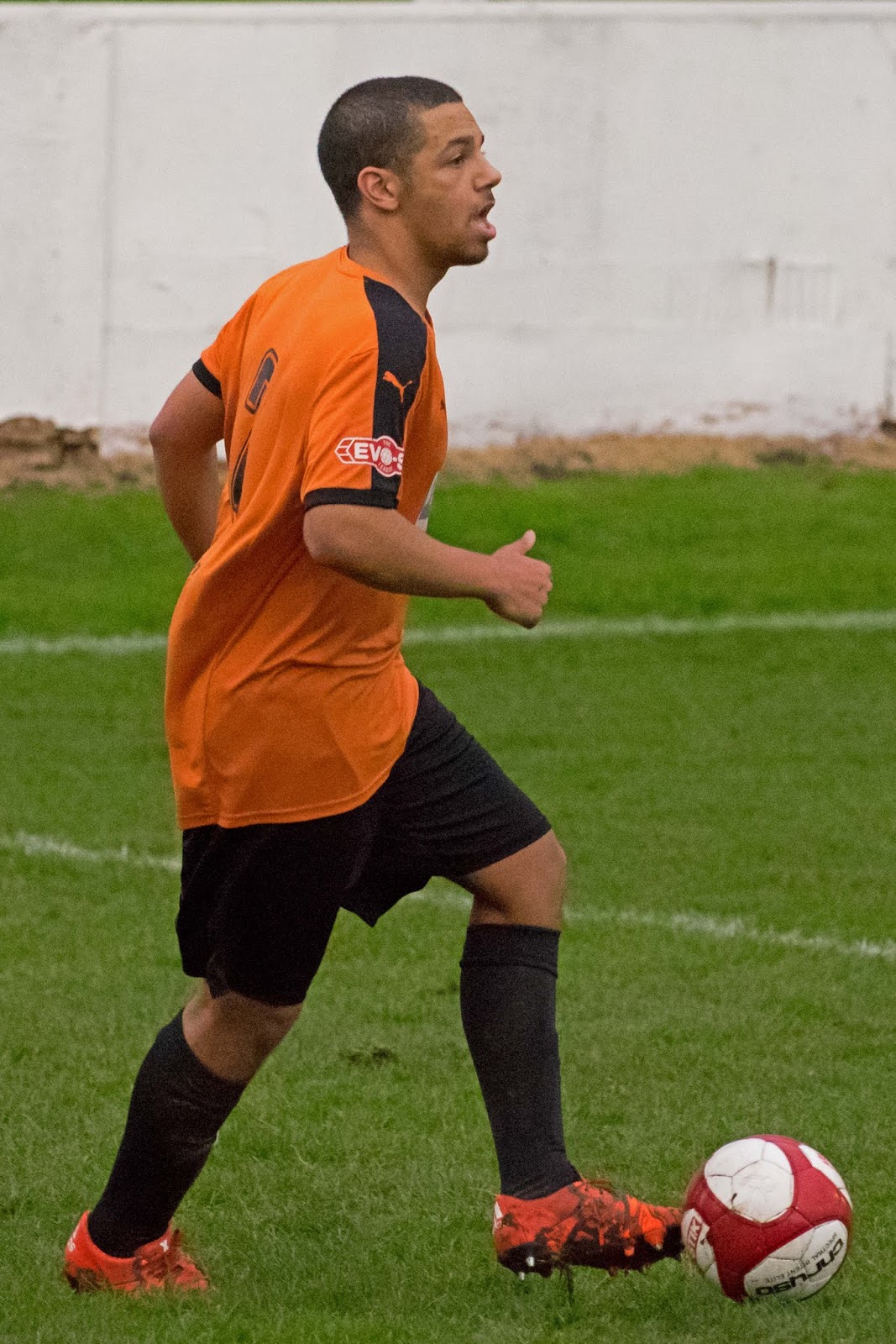
Jazz McCulloch
I was in the wrong position to capture the pre match handshakes, which is convenient for getting numbers, boots and haircuts all in a few frames to assist with captions. Numbers on the front of shirts, you know they make sense.

Both our Joe Evanses (or Joes Evans) were playing. The Joe and Joseph naming convention had been replaced by Joseph and Joseph J. Both players featured in the pictures I sent to TheNonLeague magazine: I stayed with the previous convention for now.
Joe Evans, aka Joseph J Evans
Joseph Evans, aka ... er ... Joseph Evans
It was quickly apparent this would not be one of our better performances, as we so often find at Lancaster. The hosts took the lead after 10 minutes, and added 2 more in the half hour. Any hope of coming back was probably extinguished when Lloyd Dean was sent off five minutes from the end of the half. I did not see the incident, but we then had the free kick. Waiting in the queue for the tea bar, a home supporter thought the sending off a little harsh, although retaliation (if that is what the card was for) tends to result in dismissal regardless of gravity.

My travelling companions disappeared to the pub at half time and did not return. I feel duty bound to remain in post, and was right to do so, as I like to capture players' first appearances, this time by Andy Scarisbrick. The announcer pronounced his name as written; I thought it was Scares-brick; and my friend Dr James from Crosby, not far from the village from which the name derives, pronounces it Scays-brick: none of us have had the chance to ask him. Oddly, I used the speech feature on Google Keyboard for Android to input this text before editing it manually, and it correctly spelled all three pronunciations. That was a surprise, as it always renders "goals" as "girls" - and I have never even lived in Hull.
Andy Scarisbrick
As those who went to the pub anticipated, the performance did not get better in the second half, with the hosts adding a further two goals. Our impressive home performance has still to replicate itself on the road.

The rest of the pictures from the game can be seen here.

Final score: Lancaster City 5 Prescot Cables 0.

Friday, 20 February 2015

The coach crew

Our planned trip to Prescot Cables' game away at Lancaster City was disrupted by engineering works, with replacement bus services between Preston and Lancaster. There were still a lot of trains north from Lancaster, with Virgin in particular trapping at least two 11 coach Pendolinos (or Pendolini?) where they will be lucky to carry 100 people per trip, leaving people from Liverpool, Manchester and Birmingham to squeeze into the 9 coach version. For those who like trains, the Giant Axe is a good location from which to spot them.
There's one
A few of us who would normally travel by train decided on this occasion to use the team coach. This takes away some flexibility, but once we had arrived, the town centre was a short, if steep, walk away (1 in 11, as we have been discussing gradients), so we adjourned to the Sun, a Lancaster Brewery house also offering a range of guest beers, with the choice of a tankard or straight glass.

This game would be a challenge: Lancaster are strong at home, and this was our first competitive game for three weeks. This has been a problem ever since I have been attending a majority of games rather than about a third - regardless of the manager or players, we struggle after a layoff. We tried a friendly game against AFC Liverpool in midweek, so it remained to be seen if it had helped.

We were playing with intermittent sun behind us in the first half, so I considered my best position over a portion of chips and rather decent curry sauce from the tea bar (food before photos, you know it makes sense). The cloud was mostly covering the sun by the time I started snapping in earnest, so I took up position behind the goal we were attacking.
James McCulloch
Taking photographs, you are concentrating on a small area of detail, and miss some of the wider aspects. One thing that does not escape you is which end of the pitch the action is taking place. We had a few good runs into Lancaster's half, which I captured...
James Edgar
... but we were spending most of the time in our own. It was a mark of the hosts' success keeping us contained that, when a player hit the corner flag in frustration after about 20 minutes, it stayed hit for the rest of the half.
Actually, it stayed that way until some time into the second half when Lancaster took a corner, which backs up a few grumbles about the observation skills of the match officials.

Back in the Cold War, at a United States Presidential Inauguration, you could tell when noon, the prescribed time for the transfer of power, arrived, because a gentleman of military bearing, carrying a small briefcase and sitting behind the outgoing President, got up and sat behind the new President. That briefcase contained the nuclear codes: I am not sure what was in the one substitute Sam Corlett fetched from the dressing room.
Sam controls Prescot's independent nuclear deterrent
This blog observes the occurrence of Natural Light Day, the first game of the year we are able to complete without floodlights. Technically, the game I watched last week was under natural light, but a 2.15 kick off and 80 minutes' play meant the rest of the day was my own an hour and a half before the sun went down - this was the first with conventional football timings. Ben Greenop was playing his first game for us in daylight.
Ben Greenop
With 10 minutes to go, my travelling companions decided to draw stumps (excuse the mixed sporting metaphor). I remained at my post, not least as I try to get everyone in the photos, and I knew I did not have anything of Mark McLaughlin, who has been on loan at, I think, Widnes, since the Senior Cup game, and came on as a late substitute.
Mark McLaughlin
Duty done, it was back over the hill (a location some may say I have been in for some time) to rejoin my travelling companions in The Pub (the name of the establishment, not a generic description).

The rest of the pictures from the game can be seen here.

Final score; Lancaster City 3 Prescot Cables 0.

Friday, 8 November 2013

Here be tigers

A Tuesday night visit to Prescot Cables has its intimidating features. The wind that always seems to be whipping across the pitch, the stand towering up out of the darkness, and the uncharted wilds of the gasworks side, where only the hardy tread at night.

Oddly, the visit of Lancaster City last week was the first time this season anyone has experienced these pleasures, in our first midweek home game. We have in the past entertained a Hollyoaks XI in aid of our local Willowbrook Hospice, although on this occasion some clearly felt The Only Way is Essex.
I started taking pictures in front of the tea bar, and for the second time in a row, my view was not blocked, as it normally would be, by an assistant referee. Referees at this level have a choice of diagonal, unlike in higher levels, where the left diagonal for the referee is compulsory. Use of the less common arrangement has the advantage of providing firmer footing for the assistants.
Phil Bannister, captured from the stand side
After a few minutes I joined our visiting photography student (whose name I have been told, and therefore feel embarrassed to ask again) on the gasworks side. Had I stayed put, I would probably have got a better view of our goal, from Rob Doran.
Rob Doran
At half time, I asked my fellow photographer how he was finding our floodlights. He reported that he had his ISO settings at 3200, which he did not even use indoors photographing gigs. Even at livelier gigs, the performers probably do not move as much as on the football pitch, so need slower shutter speeds. I thought use of flash may be a difference too: although flash photography is no longer prohibited by the Laws of Association Football, if it is powerful enough to make a difference, it is powerful enough to distract players and match officials. However, many entertainment venues prohibit flash, as it may induce seizures, particularly in combination with house lighting effects.

He also made an observation that illustrates the superiority of human senses over the machine, in that the light was perfectly fine to see, but less so for photography.

We thought this game might not take place: the north escaped the winds of the St Jude Storm (St Simon & St Jude surely), but it still deposited a quantity of rain the previous day. However, this day had been dry - until half time. I had looked behind the cloudy icon on the Met Office app, and spotted the 40% probability of rain, so I was prepared with my cover, whereas my colleague had used the BBC forecast, and had to put his coat over his head and camera.
James McCulloch in the rain
This turned out to be the last game of Jamie Menagh's short stay. Chester FC, with whom he had a trial in pre season, are strengthening their squad, and snapped him up, with some justification, as he impressed in his appearances for us. Dr Phil the Pharmacologist spotted the report on the Chester Chronicle site was illustrated by one of my photos: I was able to reassure him I had supplied it to the Echo (and they used in the Merseymart), and the Chronicle is part of the same Trinity Mirror stable.
Jamie Menagh
The rest of the pictures from the game can be seen here.

Final score: Prescot Cables 1 (Doran) Lancaster City 2.

Friday, 13 September 2013

Take the late train to Clarksville

I am on to about my fifth sporting trip to Lancaster, and I have failed to reach the town at the time I intended on any of them. Although there are two trains an hour between Wigan and Lancaster, they are 10 minutes apart, and seem to accumulate the same delays. I therefore allowed extra time on this occasion to get some pictures of the town in the evening light and a meal at the excellent White Cross.

Lancaster City give potential punters the opportunity to get in from whatever direction they come, with turnstiles in three corners of the ground. This allows for segregation, although I was surprised to find all three open for our visit.

At this time of year, we still have natural light at the beginning of the game, with the Met Office app telling us sunset was four minutes before kick off, although the referee started a couple of minutes early. He was clearly not expecting a shot along the ground: when I took up position behind the goal, with the game in progress, a home official was walking round with a couple of extra spikes to fix down the goal net. One would have thought that either the net was satisfactorily fixed, or it needed to be rectified before we started. The floodlights went on a couple of minutes before the start, but the natural light with a clear sky was more than sufficient whilst they warmed up.

Weekday evening games, especially away, are often a chance for new players, as some regular players will have work commitments.
Jonathan Lynch
The floodlights proved to be amongst the best in the Division. There are four pylons on each side, with three heads each of the end pylons, and two on the middle, which does not quite fit my little diagrams. Half an hour in, I was still getting good results from the end of the pitch with the shutter speed at 1/250s.
Sean Myler
I then moved round to the side, where it seemed gloomy on the terrace. This may be an indication that the lights work as they should, casting light on the pitch with minimal spillage to surrounding areas: efficient, and good for neighbourly relations in a residential area.

In the second half, I stood by the tea bar and toilet block, towards the end of one side of the ground. Results were surprisingly clear in the middle of the pitch ...
Phil Bannister and an unnamed Lancaster player. Numbers on the front of shirts need to catch on!
... and around the goal.
Antony Shinks takes a goal kick for Nick Culkin
On my side of the pitch, some results were almost good enough to use straight off the camera.
John Beattie - picture cropped, but with no lighting adjustment
The finished result, with shadows ligthened
I spent most of the rest of the game between the two dugouts, a vantage point I almost never take in daylight, as there are coaching staff, substitutes and an assistant referee legitimately getting in the way, but in the evening, the available light can make up for it.
Mike Smith takes a free kick
As for the result, the report in the Lancaster Guardian referred to our side being difficult to break down, and having dangerous attacking players, which I think is a fair assessment, but Lancaster were the better team on the night and their 2-0 win was probably a fair result.

The rest of the pictures from the game can be seen here.

Thursday, 31 January 2013

Not going to the game

When I picked up my Merseymart, and read that one of our players, Joe Fielding, had walked 3 miles from his home in Standish (which my former manager, who lives there, assured me is the posh part of Wigan) to access transport to Prescot Cables' game at Lancaster City, I felt a bit sheepish not having attended myself. Lancaster is a pleasant town, and I would have had chance to send some photos to my friend Philip from church, who watched Lancaster City when he was at University, and is now spending a year staying with his uncle in New Zealand.
Joe Fielding, on a warmer day
During a cold spell in 2009, I was talking to a Manchester City supporter, who was complaining that one of his side's fixtures, at Portsmouth, had been postponed due to a frozen pitch. The temperature had dropped to at least -5ºC, so it was within the Premier League rules, which state that grounds should be playable in temperatures down to -3ºC. However, it was a surprise that games could be postponed due to the weather, especially as he was not planning to go out in the cold, but to watch the game in a nice warm pub.

For those watching football at our level, the weather is of almost as much interest as to the farming community. When I started watching in 1991, attending winter away games was a lottery. We relied on the weather forecast on the television, or in the morning's paper, which was vague at best, and the best part of a day old. Specific information depended on a call to the club, which relied on an official being able to answer the telephone, rather than being out clearing snow or inspecing the pitch.

Technology has made things easier: club websites and social networks keep us informed of early postponements, and the Met Office website and smartphone app give local forecasts that break the day down into 3 hour segments, so you can get a reasonable idea whether your journey is likely to be fruitless. In this case, light snow had been forecast for Friday evening, turning to rain later. In the event, the forecast rain fell as snow, leaving 3 or 4 inches across the county, and bringing down power lines on the railway line between Wigan and Preston.

The things that make a place attractive to visit often disappear in the winter: the steep streets slippery with slush, the views obscured by fog, which leaves the pubs, which are all very well, but they do have them nearer home.
Lancaster - lots of fires but few televisions
Having spent some time working out alternative routes, including using the club coach, it was announced there would be a pitch inspection at 11.45, with the coach departing as soon as the result was known. With the quick route unavailable, I would need to leave home well before the inspection whatever way I chose to travel, so I tried to second guess the outcome.

When the pitch is inspected early by a local referee, he can call the game off (if he decides there is no reasonable prospect of the pitch being playable), but cannot say it will go ahead, that decision is for the match referee. As the amount of snow we had would melt to form large pools of standing water (Waterloo called off their rugby fixture for that reason), I thought a game was highly unlikely, and decided to stay put.

I was a bit surprised to find, in pictures from those who went to the game, Lancaster had received hardly any snow, in contrast with everywhere in a 50 mile radius. It might have been handy if the person on their Twitter feed who was confident about the game going ahead on Friday had shared that observation on Saturday. NASA published a photo from the morning - if you zoom in, Lancaster is in the small green bit.
I had also thought of going to London for the weekend, where I would have been able to see Dulwich Hamlet play away to Leatherhead, but decided against due to the weather between here and London. The game was abandoned after 78 minutes when about 20 people, mostly teenagers (wearing onesies for some reason I have not been able to fathom) were celebrating Dulwich's second goal, a few of them leaned on the pitch perimeter wall and found themselves flat on the ground when it collapsed. Fortunately no-one was near the wall on the pitch side. It even made The Guardian.
Although we can see all the large debris being removed, the referee considered there may be nails and broken plastic from an advertising hoarding presenting a danger to the players - not having been there, I cannot comment. Looking at people's photos, I think Leatherhead may find themselves replacing more than the collapsed section, as a couple of other bits looked less than straight, or had mortar that looked as though it may have suffered from the weather over the years.